
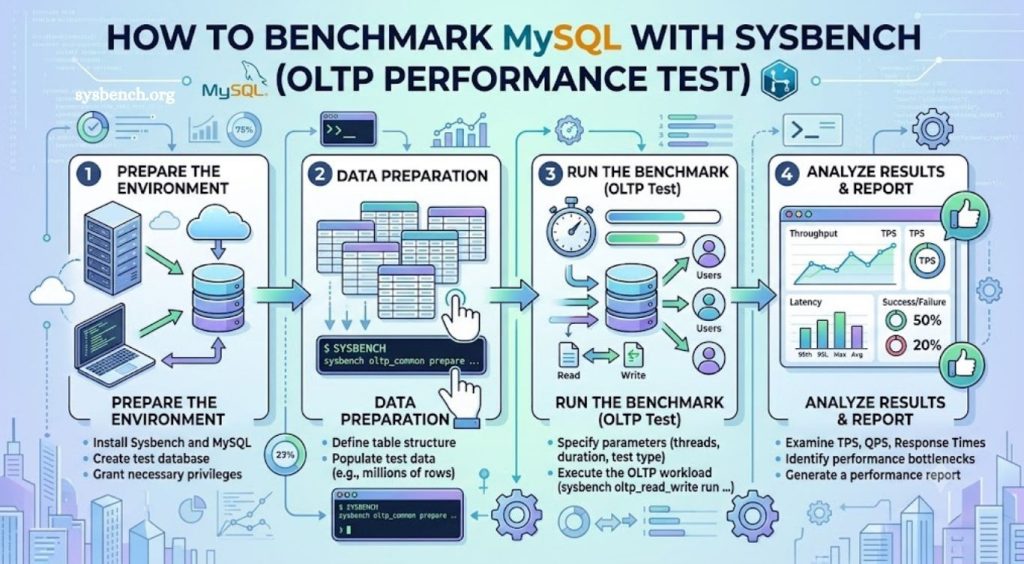
Database performance directly affects application speed, user experience, and business reliability. Every query, transaction, and connection places pressure on database resources. Measuring that pressure through accurate benchmarking helps identify bottlenecks before production workloads expose performance limitations. A reliable benchmark provides valuable insight into transaction handling, query execution, latency, and overall database efficiency under realistic conditions.
Sysbench remains one of the most trusted benchmarking tools for MySQL because it simulates real Online Transaction Processing (OLTP) workloads with impressive accuracy. Database administrators, DevOps engineers, developers, and infrastructure teams use Sysbench to evaluate hardware capacity, compare configuration changes, and validate optimization efforts. A structured benchmark creates measurable performance data that supports informed infrastructure decisions instead of assumptions.
Understanding MySQL Benchmarking
MySQL benchmarking measures database performance under controlled workloads. Rather than relying on synthetic assumptions, benchmarking generates repeatable transactions that closely resemble production traffic. These tests reveal how efficiently MySQL processes reads, writes, updates, deletes, and complex transactional operations.
Read More: How to Run the Sysbench File I/O Benchmark to Test Disk Speed?
OLTP benchmarking focuses on workloads commonly found in web applications, e-commerce platforms, banking systems, content management systems, and Software-as-a-Service environments. Since these applications depend on thousands of small transactions every minute, OLTP testing provides realistic performance measurements that represent everyday production activity.
Why Sysbench Is the Preferred Benchmarking Tool
Sysbench offers flexibility, reliability, and consistency for database performance testing. The tool supports configurable workloads, multiple thread counts, customizable table sizes, and repeatable testing scenarios. These capabilities allow administrators to compare different hardware platforms, storage devices, operating systems, and MySQL configurations using identical workloads.
Unlike simple query timing tools, Sysbench evaluates complete transactional performance. It measures throughput, response time, latency distribution, and concurrency while maintaining realistic database interactions. These metrics provide a complete picture of database behavior under pressure.
Preparing the MySQL Environment
Successful benchmarking begins with proper preparation. A dedicated testing environment prevents external workloads from influencing benchmark results. Production servers should never run heavy benchmark tests because simulated traffic consumes CPU resources, memory, storage bandwidth, and database connections.
Before running Sysbench, verify that MySQL operates normally and that sufficient disk space exists for benchmark tables. Database configuration should remain consistent throughout testing to ensure reliable comparisons between benchmark runs. Background processes, scheduled jobs, and unnecessary applications should remain disabled whenever possible because additional system activity introduces performance variability.
Installing Sysbench
Sysbench installation depends on the operating system. Most Linux distributions include Sysbench within official repositories, making installation straightforward. After installation, verify the version to confirm successful deployment before creating benchmark databases.
Using the latest stable release improves compatibility with modern MySQL versions while providing updated testing features and performance improvements.
Creating Benchmark Data
Sysbench generates benchmark tables before testing begins. This preparation stage creates records that simulate production workloads. Table size should represent realistic application data because extremely small datasets may fit entirely within memory, producing unrealistic benchmark results.
Larger datasets increase storage activity and create more representative performance measurements. Database administrators often perform multiple benchmarks using different dataset sizes to evaluate memory efficiency, storage performance, and caching behavior.
Running an OLTP Performance Test
Once benchmark tables are ready, Sysbench begins executing transactional workloads. During execution, multiple threads perform simultaneous read and write operations against MySQL. Thread count determines workload intensity, allowing testers to evaluate database scalability as concurrency increases.
Benchmark duration should remain long enough to eliminate temporary fluctuations caused by startup activities. Tests lasting several minutes generally provide more stable and representative performance metrics than extremely short executions.
Maintaining identical benchmark parameters across multiple tests allows accurate comparison between hardware upgrades, configuration changes, storage devices, and database tuning efforts.
Understanding Benchmark Results
Sysbench produces detailed statistics after each benchmark completes. Transactions per second represent overall database throughput and indicate how many complete transactions MySQL processes every second. Higher throughput generally reflects better database performance when workload conditions remain identical.
Latency measures transaction completion time. Average latency provides an overall response indicator, while maximum latency identifies occasional performance spikes. Low and consistent latency usually indicates stable database operation, whereas significant latency variation may reveal storage bottlenecks, locking issues, or insufficient system resources.
Queries per second measure SQL execution speed throughout the benchmark. Since OLTP workloads include multiple queries within each transaction, this metric demonstrates overall SQL processing capability under concurrent load.
Error statistics require careful attention because failed transactions often indicate connection limitations, configuration problems, insufficient resources, or software issues. Successful benchmarks should complete without unexpected errors or transaction failures.
Optimizing MySQL After Benchmarking
Benchmark results provide valuable guidance for database optimization. Configuration tuning often delivers measurable improvements without requiring hardware upgrades. Memory allocation, buffer pool sizing, connection management, log configuration, and storage optimization all influence benchmark performance.
Index optimization significantly improves transaction speed by reducing unnecessary table scans. Query optimization removes inefficient execution plans and lowers CPU utilization. Storage performance also affects benchmark outcomes because transactional databases depend heavily on fast disk operations.
Repeated benchmarking after each optimization verifies whether configuration changes produce measurable improvements. This methodical approach eliminates guesswork while creating reliable performance comparisons.
Best Practices for Reliable Benchmarking
Consistent testing methodology produces trustworthy benchmark results. Every benchmark should use identical database settings, workload parameters, dataset size, thread count, and testing duration whenever comparisons become necessary.
Running multiple benchmark sessions reduces statistical anomalies caused by temporary operating system activity or storage fluctuations. Averaging several benchmark results provides more accurate performance measurements than relying on a single execution.
System monitoring during benchmark execution adds valuable context by revealing CPU utilization, memory consumption, storage activity, network throughput, and disk latency. Combining operating system metrics with Sysbench statistics creates a complete performance profile that simplifies troubleshooting and optimization.
Common Benchmarking Mistakes
Many benchmarking inaccuracies originate from unrealistic testing environments. Small datasets often remain entirely within memory, preventing meaningful storage evaluation. Short benchmark durations may capture initialization behavior instead of sustained database performance.
Changing MySQL configuration between benchmark runs without documenting modifications makes performance comparisons unreliable. Similarly, running benchmarks alongside unrelated workloads introduces inconsistent resource usage that distorts benchmark results.
Ignoring latency while focusing exclusively on transactions per second also creates misleading conclusions. High throughput accompanied by unstable response times may indicate performance problems that eventually affect application responsiveness.
Conclusion
Benchmarking MySQL with Sysbench provides dependable insight into database performance under realistic OLTP workloads. Accurate testing reveals throughput, latency, scalability, and resource utilization while identifying opportunities for optimization before production environments encounter performance limitations.